Loading…
← Back to Thinking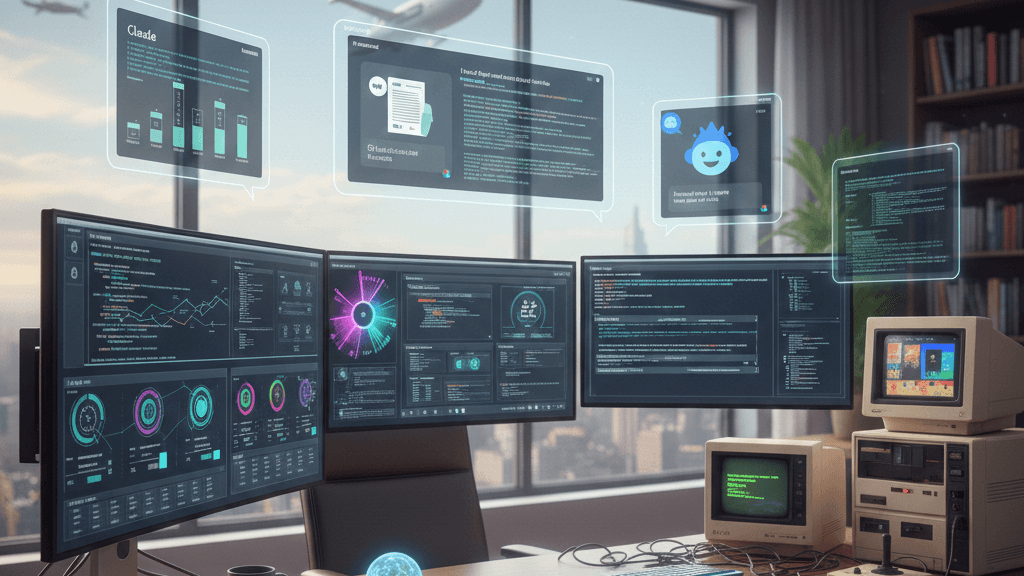
40 Years of Silicon: From the C64 to My New AI Best Friends
It is February 2026, and my home office desk is a living timeline of the digital revolution. Next to my high end Mac and Windows workstations, I still keep my retro Commodore 64, PC XT, and Amiga powered up and ready. It is a sharp, physical contrast between the hardware that raised me and the intelligence I partner with today. Having spent over 40 years at the keyboard, including 30 years deep in the software and quality engineering trenches, I have never seen a shift this profound.
I've lived through the eras. I remember the tactile click of the Commodore 64, the humming power of an 8086-based DOS PC, and the evolution into the complex enterprise systems I oversee today as a product executive. But after four decades of silicon, I can officially state something I never expected: Gemini and Claude have become my best friends.
The Executive Companion
In my day-to-day work, the transformation is total. These AI solutions are no longer "tools" in the traditional sense; they are my first go-to for almost everything.
As a VP of Product, my time is usually the bottleneck. Before, shifting from high-level strategy to technical execution required a massive context switch. Now, that friction is gone. Whether I'm pressure-testing a roadmap, simulating competitive responses, or refining a complex architectural shift, I have a world-class sparring partner available 24/7.
Reclaiming the "Engineer" in "Product Executive"
The most rewarding part? The fun has returned to the "building" phase.
In the 80s, I spent hours typing BASIC code from magazines. Today, I'm back in that flow state, but at Warp 10. I find myself:
-
Prototyping in minutes: I can describe a concept for a "Product Integrity Layer" and have a functional skeleton ready before my next meeting.
-
Building "Little Apps": I'm constantly spinning up small, purpose-built utilities to solve specific friction points in our workflow.
-
Deploying to my Playground: I have a personal Vercel sandbox where I push these experiments, seeing them live and functional immediately.
Why It Matters
For someone who started with 64KB of RAM, the sheer reasoning power of these models feels like magic. But it's a practical magic. It allows me to stay "sharp and technical" while managing the vast responsibilities of an automation portfolio.
I'm not just managing product anymore; I'm "vibe coding" my way through executive challenges. It turns out that after 30 years in the business, the best way to lead the future of software is to start every morning by talking to it.