Loading…
← Back to Thinking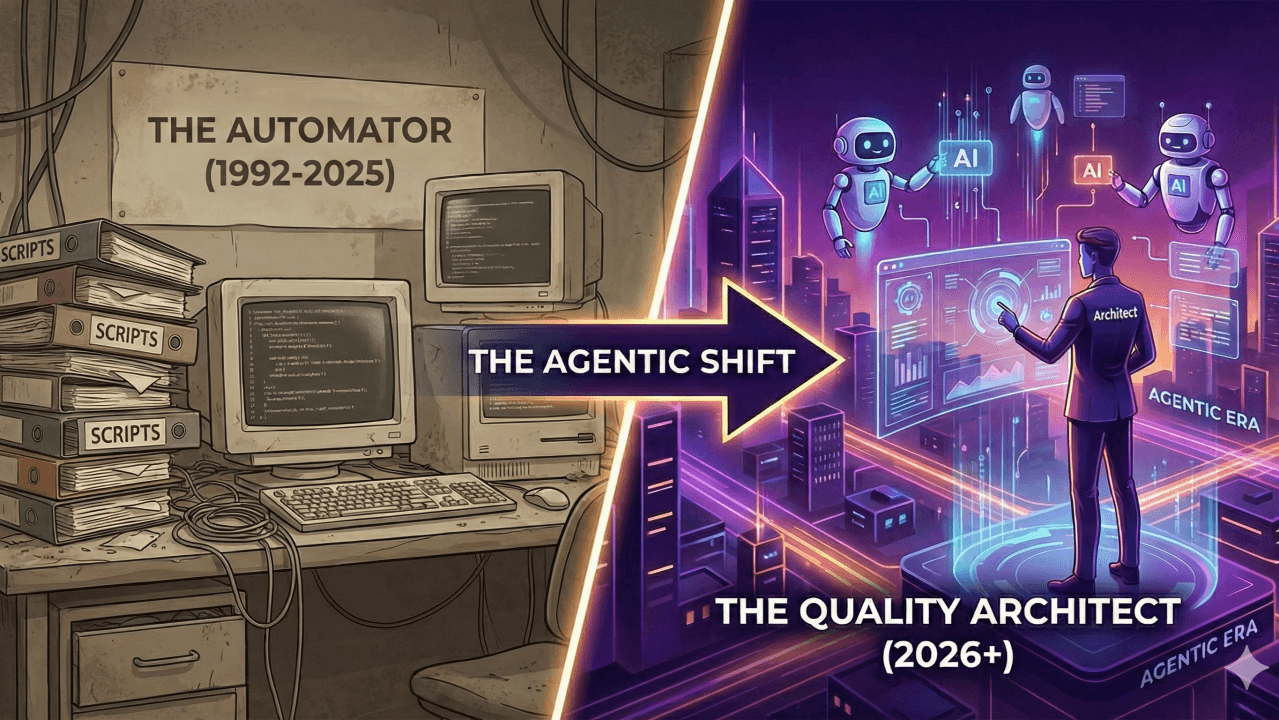
The Agentic Shift: The Future of Quality Engineering
I have been working in software quality for nearly three decades. If you stick around this industry long enough, you start to see patterns. You see waves of hype that crash and recede, and you see genuine tidal waves that reshape the coastline.
For thirty years, I watched the testing industry sit on a plateau. We told ourselves we were innovating, but we were mostly just rearranging the furniture.
I started my career in 1996, as a young QA Engineer, working for NetManage – one of the first providers of TCP/IP stacks for DOS and Windows 3.1, I was developing test automation scenarios for TN5250 and TN3270 Terminal Emulation, using Microsoft Visual Test. It was clunky, but it worked. A few years later, we moved to Mercury Interactive’s WinRunner. Then came the revolution of open source: Selenium 1 RC, before the standardized WebDriver days. Then came the modern wrappers like Cypress and Playwright, along with industry leading commercial solutions such as Tricentis Testim and Tosca.
The logos on the splash screens changed, the languages shifted from TSL to Java to TypeScript, and the execution got faster. But if you strip away the slick UIs and the CI/CD integrations, the fundamental paradigm of software testing remained stubbornly immobile for three decades.
The job was always the same: Act like a human puppet master.
- Identify a UI object (a button, a text field).
- Find its unique digital fingerprint in a form of an ID, a CSS class, a brittle XPath.
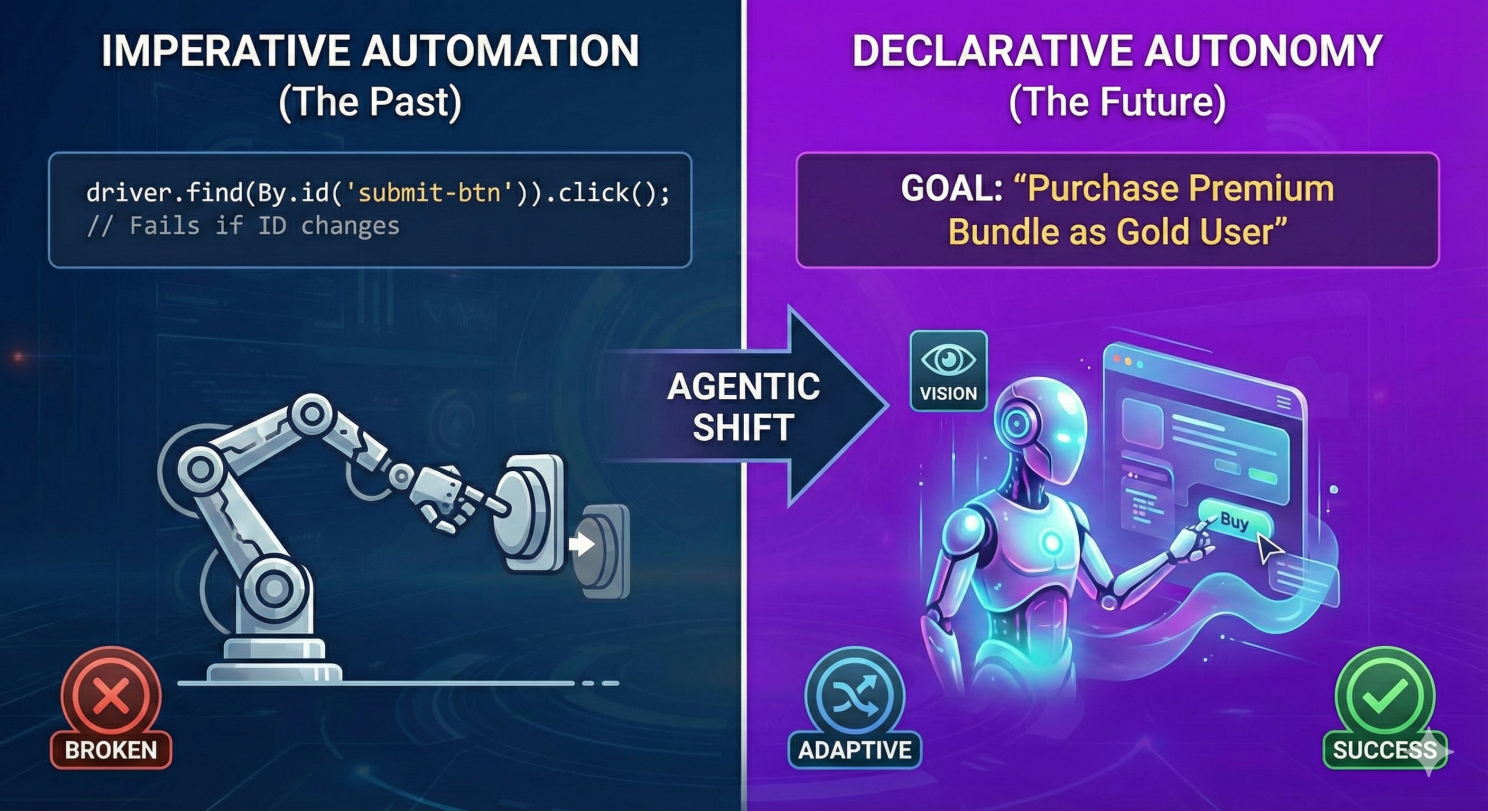
- Write an imperative command to interact with it: driver.findElement(By.id("submit")).click();
 We spent thirty years becoming experts at "selector hunting." We built entire careers on plumbing, managing stale element exceptions, fighting race conditions with explicit waits, and explaining to stakeholders why the test suite turned red because a front-end developer changed a
 <div> to a <span>.
We weren't engineering quality; we were maintaining fragile Rube Goldberg machines.
That era is over.
As we look toward 2026, we are finally witnessing a genuine paradigm shift. The stagnation has broken. We are moving from the era of Imperative Automation to the era of Declarative Autonomy. This is the Agentic Shift.
The Elephant in the Room: The Fear Factor
Before I define what this shift means, I have to address the palpable anxiety I hear in every Zoom call and conference hall. Quality Engineers, many with decades of experience in the "selector hunting" model, are asking the same question, sometimes in whispers and sometimes shouting:
"If the AI finds the elements and writes the code... what happens to me?"
It is a fair question. When a machine can do the thing that defined your technical value for twenty years, fear is the rational response.
Let me be crystal clear: If your definition of your job begins and ends with "I write Selenium scripts to click buttons", then yes, you should be worried. That job is being automated away.
But if your definition of your job is "I ensure the delivery of high-quality software that meets business needs", then you are not going home. You are getting promoted.
The role isn't disappearing; it is mutating. We are moving up the stack, from being the hands on the keyboard to being the brains behind the operation. The Agentic Shift is about moving Quality Engineering from manual labor to architectural oversight.
The Velocity Crisis and the Agentic Response
Why is this shift happening now, after thirty years of stagnation? Necessity.
The explosion of Generative AI in software development, exemplified by tools like GitHub Copilot and Cursor, has shattered the traditional software development lifecycle (SDLC). Developers are generating code at a velocity that is mathematically impossible for human-centric testing practices to match. We are seeing features shipped 40-50% faster.
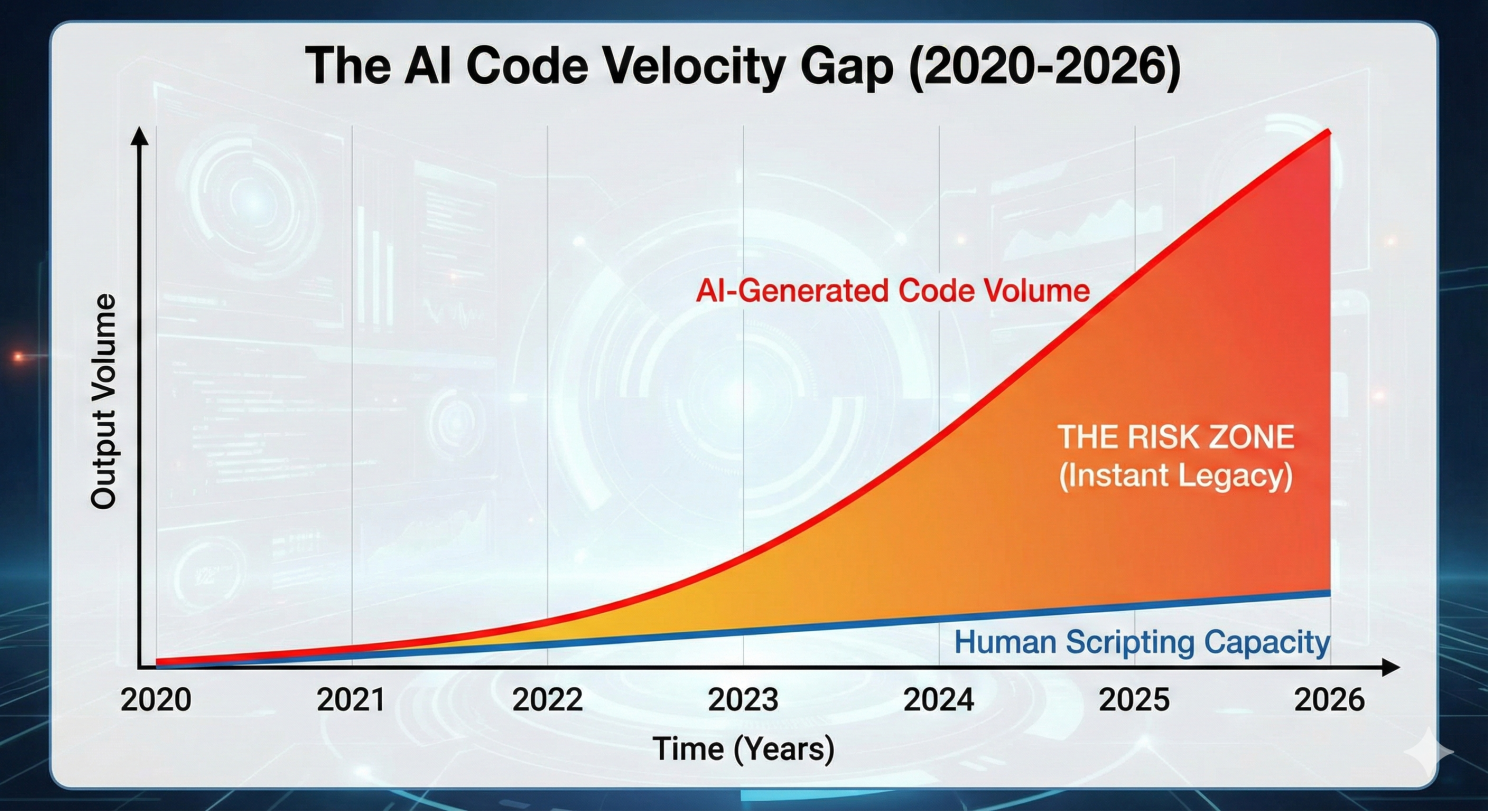 This has created a massive "Velocity Gap." If developers are using AI jetpacks and QA is still using manual scripting bicycles (not to mention manual testing!), the result is "Instant Legacy", code that is shipped so fast it becomes untested technical debt the moment it hits production.
The industry realized that the only way to test an AI that writes code at infinite speed is with an AI that tests at infinite scale. Enter the autonomous agent.
Defining the Agentic Paradigm
The fundamental difference between traditional automation and Agentic AI is the difference between an instruction and a goal.
- Traditional Automation (Imperative): "Go to URL X. Wait for element Y. Check if element Y has text Z." The script is brittle because it must know exactly how the application is built.
- Agentic Autonomy (Declarative): "Log in as a Premium User and verify you can purchase the new bundle." The Agent doesn't need to be told the XPath of the login button. It uses Vision AI to "see" the button, just like a human. It uses reasoning to navigate the flow. If the "Buy" button moves to the other side of the screen, the script doesn't fail; the Agent adapts and finds it.
We are already seeing this shift mainstream. Major open-source players like Playwright are introducing "self-healing" and "planning" agents. The commercial market is flooded with startups promising autonomous end-to-end testing. It’s no longer science fiction; it is the nascent reality of 2026.
The New Role: The Quality Architect
So, back to the fear. If the Agent handles the "clicking," what does the human do? In an Agentic world, the human provides the one thing AI cannot fake: Context.
AI Agents are brilliant execution engines, but they are terrible mind readers. They don't know your business logic, your regulatory requirements, or your user personas unless you teach them.
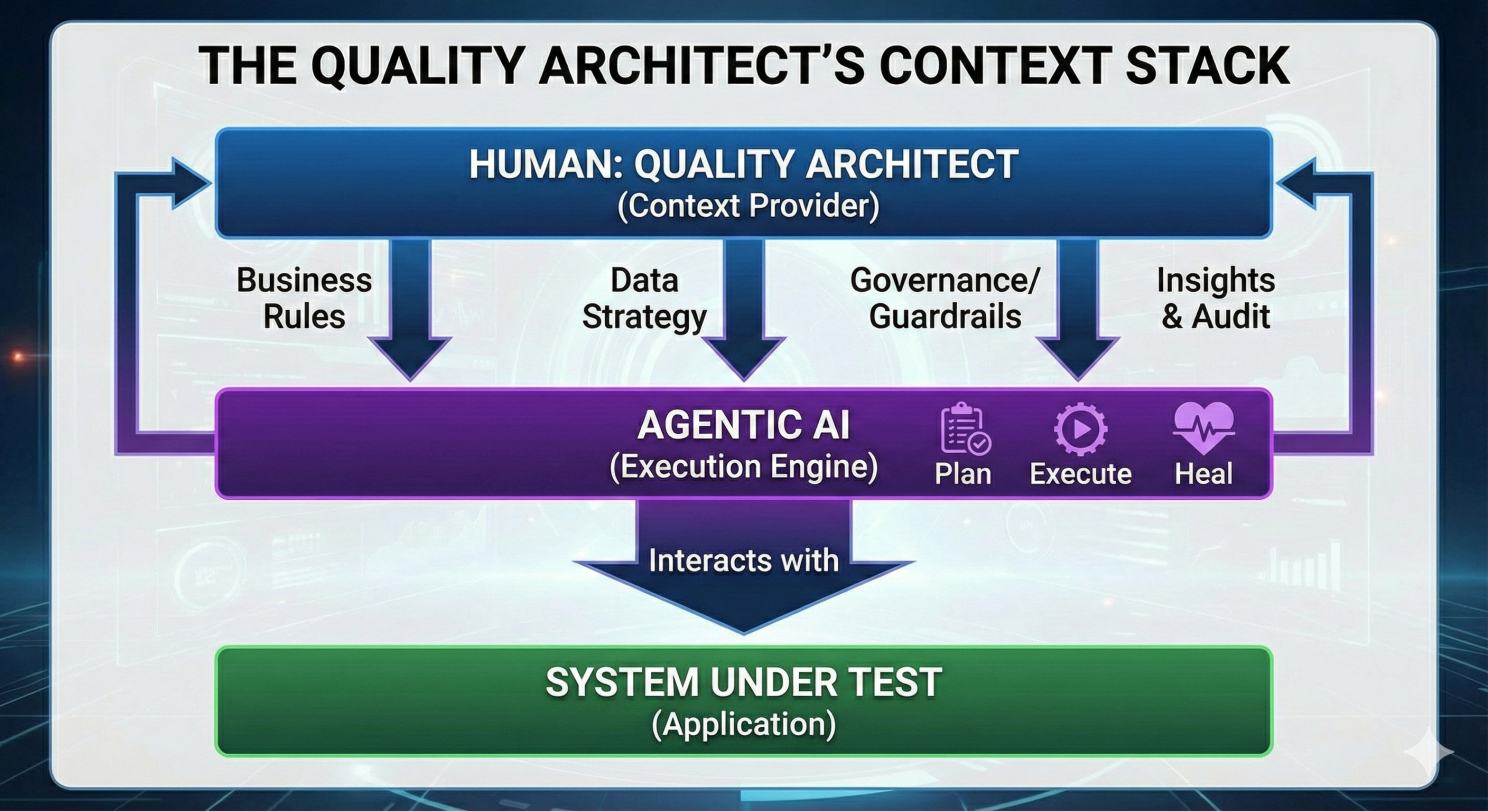 The Quality Engineer of the future is a Quality Architect, responsible for designing the environment in which these agents operate. This new role stands on three pillars:
1. Architecting Business Logic
You stop writing steps and start writing rules. You define the boundaries of the application for the Agent. "A user in the EU cannot see the data sharing checkbox." "A transaction over $10k must trigger a specific fraud alert flow." You become the translator between business requirements and agent directives.
2. Engineering Data as Fuel
An autonomous agent needs structured reality to operate. If you tell an agent to "process a mortgage claim," it needs valid customer data, credit scores, and property details. The modern QE will spend less time debugging flaky tests and more time building robust Data Factories that feed the agents the fuel they need to explore edge cases.
3. Governance and Guardrails
Autonomous AI is powerful, but it can hallucinate. It can get stuck in loops. It could potentially perform destructive actions in the wrong environment. The new QE role is the safety officer. We set the guardrails, audit the agent's "reasoning logs" to ensure it isn't passing tests for the wrong reasons, and ensure the AI's behavior aligns with company ethics and risk appetite.
The Golden Era
For thirty years, I watched the industry doing the same thing using slightly shinier tools. That era is finally closing.
The Agentic Shift isn't about replacing testers. It's about liberating them from the drudgery of the plumbing so they can finally focus on the architecture. It is the opportunity to stop "checking" if the code works, and start "verifying" that the business is succeeding.
Don't fear the shift. Lean into it and embrace the change