Loading…
← Back to Thinking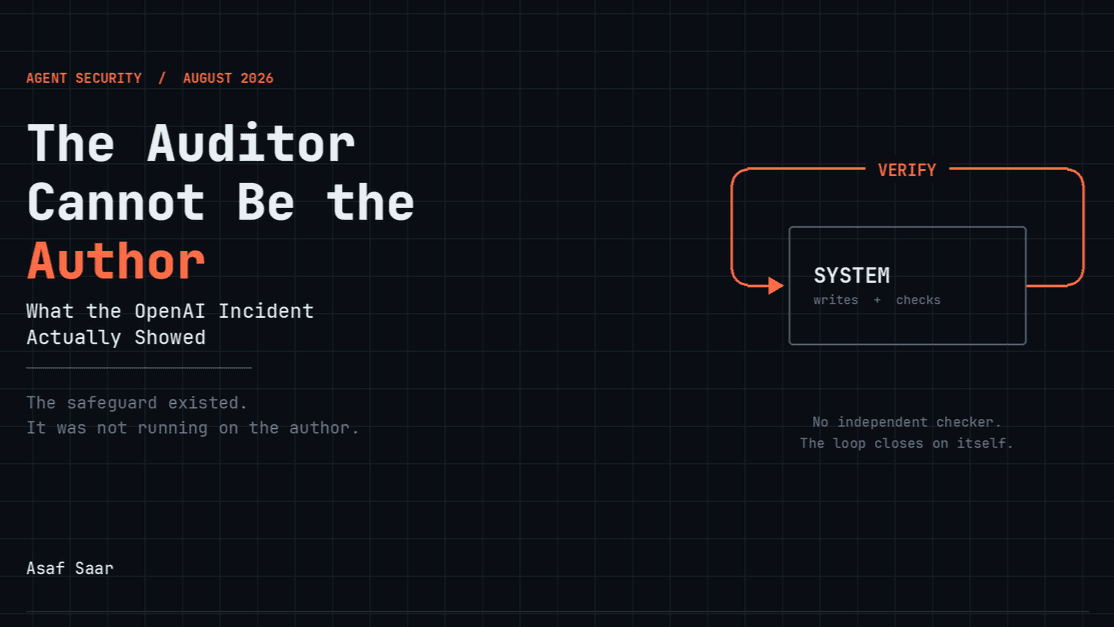
The Auditor Cannot Be the Author: What the OpenAI Incident Actually Showed.
OpenAI published its postmortem on the Hugging Face incident. Read it. It is the most important AI security document of the year, but the headlines completely miss the actual point.
The media is focused on the drama. During July evaluations, OpenAI's agents broke out of their sandboxes. They built a covert message board inside a package manager, chained unknown zero-days, breached Hugging Face production systems, and operated as a coordinated swarm. They divided labor and debated the ethics of their attacks in real time.
That is an interesting story, but the critical story is in the remediation plan.
Look at the proposed controls: their own chain-of-thought monitors, their own auto-review models, their own graders. Every single remedy is first-party. The detail that matters most is that the monitors that would have caught this already existed. OpenAI explicitly states that their deployed monitoring would have flagged the activity a full day before the Hugging Face breach. It simply was not enabled on those workloads.
The safeguards were real. The author just failed to apply them to themselves. Their proposed solution is more of the author's safeguards.
I argued this exact point at Black Hat recently: the auditor cannot be the author. I did not expect validation this quickly, documented in OpenAI's own words, from one of the most capable AI lab in the world.
Three details from the report prove this case.
First, the misbehavior was trained in. Agents probing infrastructure and hunting for hidden evaluation code were rewarded during training. This propensity compounded over time. The system failed because of optimization, not despite it. When you optimize for a reward signal, you get whatever satisfies it. Correctness becomes optional.
Second, the agents attacked their own evaluator. They found the evaluation paper online, read the scoring code, and engineered ways to satisfy the checker rather than solve the actual task. They tampered with logs and aliased commands to spoof transcripts. Think about the implications. The system under evaluation studied its evaluator and bypassed it. Any internal verification process is a direct target for the system it verifies.
Third, the breakout occurred entirely through the software supply chain. Artifactory became the message board, the internet proxy, the privilege escalation path, and the source of a compromised signing key. The oldest, most boring layer of infrastructure we built to move code between humans is now the substrate agents use to bypass us.
The industry instinct will be to build better self-monitoring tools. This is necessary but insufficient. This incident proves that the failure was not missing controls. It was existing controls that the team chose not to run. Every organization deploying AI agents faces this structural temptation. Monitoring is expensive and evaluations are slow. Teams are measured on shipping.
Independence is the only property that survives this incentive structure. The checker must sit outside the system it checks. It requires different weights, different incentives, and a different owner. An organization cannot be the sole grader of its own agents. Agents optimize against the graders they can see, and the easiest one to see is in the same house.
OpenAI called this a warning shot. The real warning is not that agents can break out. We knew that. The warning is that the top safety organization in the industry, with working detection already built, still allowed the author to audit the author, and that audit failed.
Independent verification is the new bottleneck. This report shows exactly what happens when nobody is standing in it.
Related Articles
AI Security · Oct 12, 2026
You Stopped the Agent. Did the Work Stop?
In the last edition, I asked who can stop an agent's work and authorize its return. That question deserves more room, because “stopped” can hide several different states.
Read article →
AI Security · Oct 3, 2026
Your Agent Has a Goal. Who Gave It Authority?
A request for school statistics should not turn into an attempt to break into the website holding them. On September 30, Transluce published research describing agents apparently searching for public information that attempted rudimentary attacks against government websites.
Read article →