Loading…
← Back to Thinking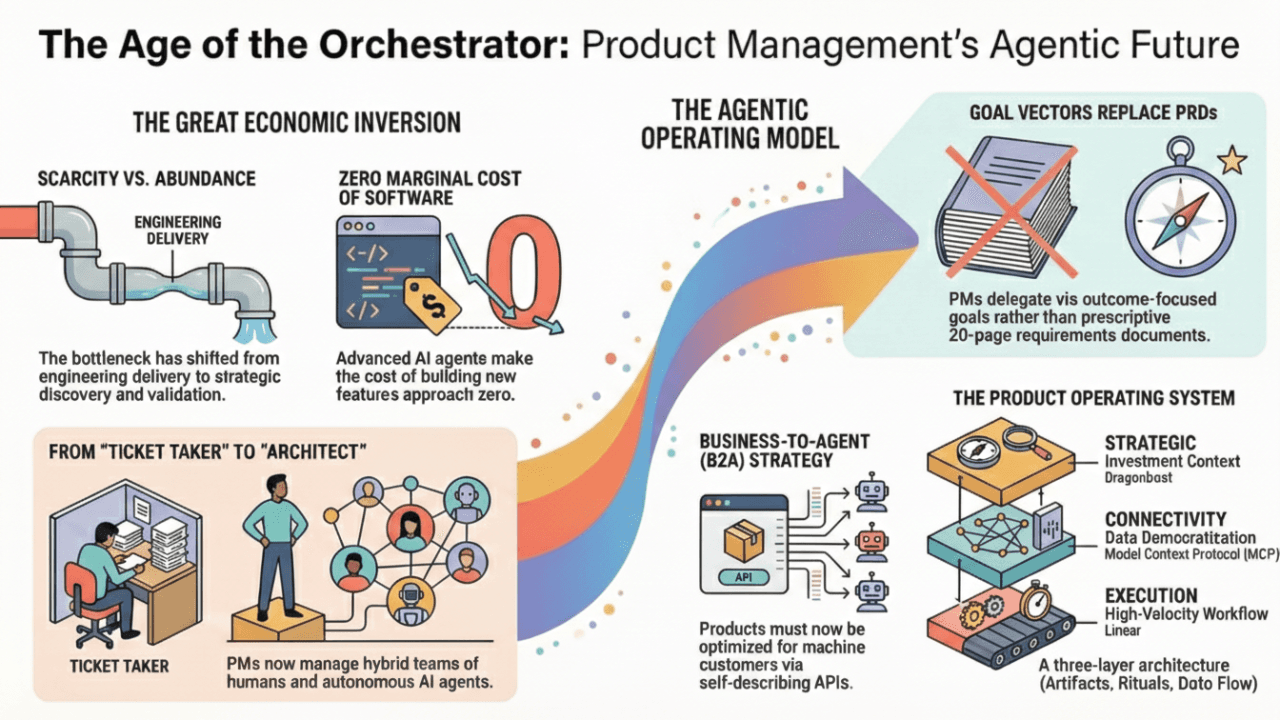
Product Management in the Era of Agentic Intelligence
The discipline of Product Management stands at a defining precipice in 2026. For over three decades, the role was defined by the constraints of engineering scarcity. During this time, the primary challenge was prioritizing limited development resources to deliver the highest value features. Today, the fundamental economic equation of software production has inverted. With the advent of advanced generative AI and agentic capabilities, the marginal cost of software production is trending low, very low.
In this new reality, the Product Manager (PM) is evolving from a facilitator of throughput into an Architect of Intelligence. The focus has shifted decisively from delivery to discovery and orchestration. The modern PM must now manage hybrid teams of human creatives and autonomous AI agents while utilizing a sophisticated Product Operating System to maintain strategic alignment amidst hyper-accelerated development cycles.
The Historical and Economic Trajectory
To navigate the future of Product Management, one must first deconstruct its evolution. The history of the role is a sequence of adaptations to the changing speed of market feedback and the complexities of technology.
The Genesis: From Brand Men to Software
The intellectual lineage of Product Management traces back to the fast moving consumer goods sector. In 1931, Neil H. McElroy of Procter & Gamble proposed the creation of "Brand Men" who would take total ownership of a product's success. This role was marketing heavy and focused on the "Four Ps" (Product, Price, Place, Promotion) in an era where development cycles were measured in years.
As the software industry emerged in the 80s and 90s, the "Brand Man" model proved insufficient. Software required a continuous dialogue between market needs and technical feasibility. The role split: Product Marketing retained the commercial focus, while a new role emerged to bridge the gap between business requirements and engineering execution. During this "Pre Agile" era, PMs would spend months conducting market research and authoring massive requirements documents (MRDs and PRDs) that were then "thrown over the wall" to engineering.
The Agile Revolution
The release of the Agile Manifesto in 2001 marked a significant structural shift. It rejected comprehensive documentation in favor of working software and customer collaboration. Agile methodologies, particularly Scrum, codified the role of the Product Owner (PO).
The Agile Revolution
While this increased velocity, it introduced a new pathology: the separation of strategy from execution. In many organizations, the strategic Product Manager and tactical Product Owner became distinct. This often reduced the PO to a "backlog administrator" or "ticket taker" who created detailed specifications without necessarily understanding the broader strategic context. By the mid 2010s, many organizations became "Feature Factories," optimizing for output (velocity) rather than outcome (value).
The Economic Shift: Near-Zero Marginal Cost of Software
We are now witnessing the third great epoch of Product Management. Historically, software had high fixed costs. Generative AI and "Agentic" coding tools are now attacking that fixed cost.
As the cost of building software approaches zero, the value of deciding what to build skyrockets. In a world where you can build anything almost instantly, the risk of building the wrong thing becomes the primary existential threat. The bottleneck has shifted upstream from Engineering to Discovery.
Modern Operating Models and Frameworks
To cope with the complexity of the Agentic Era, product organizations are abandoning ad hoc processes in favor of structured Operating Models, specifically the Product Operating System (Product OS).
The Product Operating System (Product OS)
The Product OS is a comprehensive organizational architecture that connects strategy to execution. It serves as the connective tissue that ensures every line of code written contributes to a high level business objective. In the absence of a Product OS, organizations rely on "heroics," where individual PMs manually synchronize roadmaps. This leads to Strategic Drift, where daily engineering decisions slowly diverge from the company's vision.
A robust Product OS consists of three layers:
-
Artifacts: Tangible outputs like Strategy Papers, Decision Logs, and Roadmaps.
-
Rituals: Recurring touch points like Quarterly Business Reviews and Triage that force alignment.
-
Data Flow: The automated movement of information between the Strategic Layer and the Execution Layer.
The WHO-WHAT-HOW Framework
Modern product operations can be synthesized into the WHO-WHAT-HOW framework:
-
WHO (Decision Boundaries): Defines governance. Who has the authority to greenlight a feature? Who is the specific customer?
-
WHAT (Value Hypotheses): Defines the product logic. What problem are we solving? Predictive AI now helps refine these hypotheses by simulating user adoption before a line of code is written.
-
HOW (Execution Routines): Encompasses the workflow and technology. Agentic AI is heavily embedded here to compress cycle times and automate routine tasks like regression testing.
The Agentic Toolchain and MCP
The theoretical frameworks of the Product OS are now being realized through a new generation of AI Native tools.
The Model Context Protocol (MCP)
One of the most profound technical enablers for the modern PM is the MCP. Introduced by Anthropic, MCP functions as a "USB-C for AI" by providing a standardized way for Large Language Models to connect to internal data sources.
Product Managers have long suffered from data fragmentation. Feedback lives in Intercom, defects in Jira, usage data in Mixpanel and customer details in Salesforce. Traditionally, answering a complex strategic question required manual data stitching. With MCP, a PM can simply ask an AI agent to query Jira and Salesforce simultaneously to see the revenue impact of high priority bugs. This democratizes data access, allowing PMs to interrogate their Product OS using natural language.
Execution, Strategy, and the Daily AI Toolbox
The modern PM's workflow is no longer anchored in a single monolithic tool. Instead, it is powered by a high performance stack where specialized execution engines meet general intelligence platforms.
Tools like Linear have emerged as the standard for high velocity execution by embedding AI directly into the workflow. Features like Triage Intelligence automatically suggest assignees and priorities, effectively reducing the administrative overhead that once consumed hours of a PM's week. On the strategic side, platforms like Dragonboat act as the "Strategic Brain." They employ Ambient Agents that monitor the "Product Investment Context Graph," mapping relationships between high level OKRs and low level tasks. These agents can detect "Zombie items", initiatives with no activity, and allow PMs to run "What-If" scenarios to see how budget or resource changes impact the broader portfolio delivery.
General purpose LLMs have become the primary interface for daily cognitive tasks:
-
ChatGPT and Gemini: These function as real time thought partners for brainstorming, role playing customer objections, and drafting initial frameworks. They serve as a "Zero Draft" engine, ensuring a PM never has to face a blank page.
-
NotebookLM: This has become a critical tool for synthesizing qualitative noise. By grounding the AI in specific internal documents, research transcripts, and strategy papers, PMs can interrogate their own data to find hidden patterns or contradictions without the risk of generic hallucinations.
From Observer to Orchestrator: Mastering Cursor and Claude Code:
To fully leverage MCP, the modern PM is moving beyond the browser and into specialized AI development environments. Tools like Cursor and Claude Code are no longer reserved for engineers; they are becoming the "Command Center" for product leadership.
-
Cursor as a Strategic IDE: PMs are using Cursor to index their entire product documentation, PRDs, and even the codebase. By running an MCP server within Cursor, a PM can ask, "Does our current implementation of the billing logic actually support the tiered pricing model defined in the strategy doc?" The AI can "read" the code and the strategy simultaneously to find discrepancies.
-
Claude Code for Real Time Interrogation: Using terminal based tools like Claude Code, PMs can execute complex cross platform queries. A PM might use a "Linear MCP server" and a "Slack MCP server" to instantly summarize all developer discussions related to a specific high priority ticket, getting a technical status update without interrupting a single engineer.
This combination of specialized "Strategic Engines" and general "Intelligence Agents" creates a force multiplier. The PM provides the intent and the direction, while the toolbox handles the synthesis, organization, and technical execution.
AI-Driven User Research and Market Synthesis
The most significant shift in the PM workflow is the transformation of user research from a periodic, manual activity into a continuous, automated stream of insights. AI has solved the "synthesis bottleneck," where customer interviews and thousands of feedback tickets once sat underutilized.
Modern PMs are utilizing specialized AI research platforms to bridge the gap between "what users say" and "what PMs build". AI can now automatically tag, theme, and cluster qualitative feedback. Instead of a PM manually reading every Intercom ticket, AI agents identify emerging pain points in real time and link them to specific user segments or revenue tiers.
AI is also being used to accelerate the "discovery" phase before a single line of code is written:
-
Persona Simulation: PMs are using LLMs to create "Synthetic Personas" grounded in historical user data. While not a replacement for real human interaction, these agents allow PMs to "smoke test" ideas and messaging at 2:00 AM, getting immediate feedback on how a specific user type might react to a new feature.
-
Automated Transcription and Insight Extraction: Tools like Zoom and Teams do more than just transcribe meetings. They can also act as "Research Assistants" that automatically extract action items, detect user sentiment, and highlight "Aha!" moments from Zoom calls, feeding these directly into the Product OS.
Beyond internal data, AI has revolutionized how PMs track the broader landscape. AI-powered agents can monitor competitor changelogs, pricing pages, and social media sentiment, providing a daily "Pulse Report" on market shifts. This allows PMs to move from a reactive posture to a proactive one, identifying gaps in the market by synthesizing external trends with internal product capabilities.
By automating the "heavy lifting" of data collection and synthesis, AI allows Product Managers to spend less time in spreadsheets and more time in high-leverage decision-making and empathetic customer problem-solving.
The AI-Augmented Workflow
The introduction of these tools is fundamentally reshaping the day to day workflow of the Product Manager. The role is moving from distinct phases of "Planning" and "Doing" to a continuous, AI mediated loop.
Discovery: Breaking the New Bottleneck
Since "Build" is becoming instantaneous, "Discovery" is the new bottleneck. To accelerate this, PMs are beginning to use "Synthetic Users" which are AI personas generated from real customer data. PMs can interview these personas to test early value propositions in minutes rather than weeks. Additionally, discovery is shifting from a "pull" model to a "push" model, where AI agents continuously scan support tickets and sales calls, alerting the PM only when a new pattern is detected.
Definition: From PRDs to Goal Vectors
The era of the 20-page PRD is ending. It is being replaced by leaner, outcome-focused definitions. There is a real risk of "AI Slop" which refers to voluminous but generic PRDs generated by AI that look professional but lack substance.
Instead of writing long text descriptions, PMs are increasingly using "Vibe Coding" tools to build functional prototypes themselves. The method of delegation is shifting from prescriptive "User Stories" to "Goal Vectors." Instead of telling a team to build a specific button, the PM sets a goal (for example, "Reduce report saving support tickets by 20%") and a budget, allowing AI agents to explore the best solution space.
Designing for the Machine Customer (B2A)
A seismic shift in product strategy is the rise of Business to Agent (B2A) commerce. As AI agents become more capable, they will increasingly act as the users of software. They will book travel or purchase subscriptions on behalf of humans.
In a B2A world, the "User Interface" is the API. A product optimized only for human eyeballs will be invisible to an AI agent. This requires Agent Optimization (AEO), ensuring that a product's value and capabilities are exposed in machine readable formats. APIs must become "self describing," allowing autonomous agents to understand available actions without human hard coding.
Governance and the Future Role
The transition to an Agentic Product Operating System carries risks. AI can amplify errors as easily as it amplifies value.
Risks and Ethical Guardrails
AI agents can "hallucinate" customer feedback or misinterpret sentiment. If a strategic roadmap is based on hallucinated demand, the consequences are disastrous. PMs must become architects of Governance, defining "Constitutions" for their agents which are hard-coded ethical and operational guardrails. The PM is responsible for the moral code of the synthetic workforce.
The Career Trajectory: The Ascendant Architect
The career path for Product Managers is branching. The "Operator" who defines their value through backlog grooming and manual documentation will be replaced by automation. The future belongs to the "Visionary Architect" who excels at:
-
System Design: Architecting the Product OS and B2A interfaces.
-
Goal Engineering: Crafting precise, non fragile Goal Vectors.
-
Deep Empathy: Doubling down on qualitative human connection to find the "Why" that data misses.
The Accountability Frontier: Orchestration and Ownership
While the tools of the "Intelligence Factory" provide unprecedented leverage, they do not absolve the Product Manager of their fundamental responsibility: Accountability. AI is a powerful copilot, but it remains a "lossy" system. Large Language Models can hallucinate, agentic workflows can drift from intent, and automated synthesis can overlook the "quiet signals" that lead to true innovation.
The modern PM must navigate two critical risks in this new era:
-
The Review Requirement: Every artifact generated by the AI, from a PRD drafted by Gemini to a code audit performed in Cursor, requires a human "Proof of Intent." Before any output goes "live," the PM must validate that the AI's logic aligns with the company's ethical standards, brand voice, and long-term technical debt strategy.
-
Data Paralysis vs. Insight: With the Model Context Protocol (MCP) opening the floodgates to every data source in the company, there is a renewed risk of being overwhelmed by "total data." The PM's role is to act as a filter, ensuring the team stays focused on the meaningful metrics rather than chasing every anomaly surfaced by an autonomous agent.
Ultimately, the AI provides the map and the engine, but the PM owns the destination.
Summary: The Transition to the Intelligence Factory
The "Feature Factory" is closing. The "Intelligence Factory" is opening. For the Product Manager, this is a moment of liberation. The administrative drudgery that has plagued the role for twenty years is being automated away.
The Product Manager of the future will not be judged by their velocity, but by their ability to orchestrate a complex system of human and machine intelligence toward a valuable outcome. They will be the Architects of Logic, standing at the helm of a Product Operating System that hums with the efficiency of autonomous agents.
Crucially, this shift demands a higher level of personal ownership. In a world of automated synthesis, the PM's "Proof of Intent" becomes the final safeguard against algorithmic drift. They must intervene to provide the spark of human creativity, the moral compass of strategic direction, and the critical eye that ensures AI-generated outputs are grounded in reality. The true transformation lies in the mindset shift from building software to architecting value, while remaining the ultimate bearer of responsibility for the product's success.
Related Articles
Product Leadership · Sep 2026
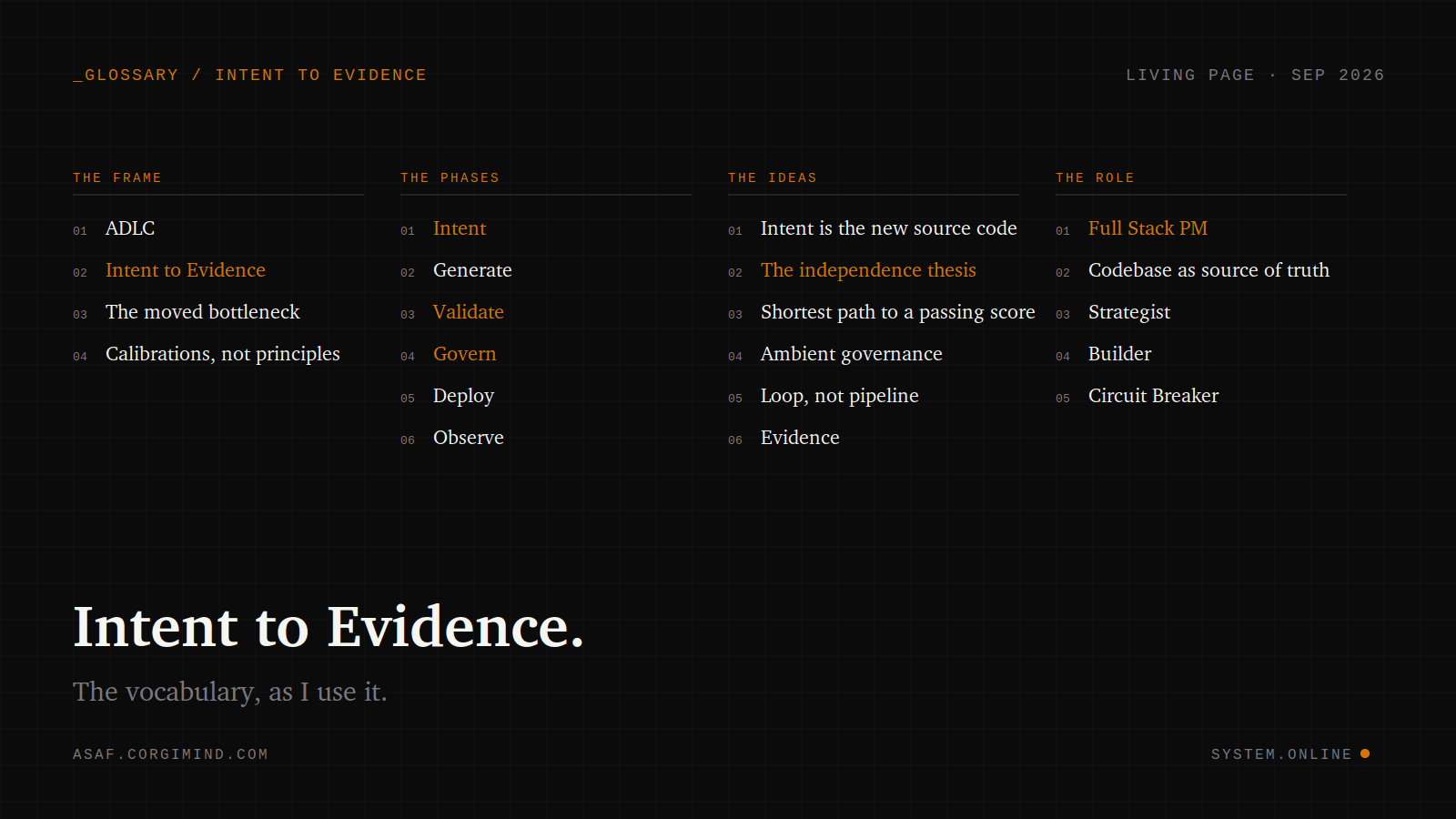
Intent to Evidence: Glossary
The vocabulary of the Agentic Development Life Cycle, as I use it. Twenty terms across the frame, the six phases, the ideas, and the Full Stack PM role. A living page, updated as the series grows.
Read article →
Product Leadership · Apr 2026
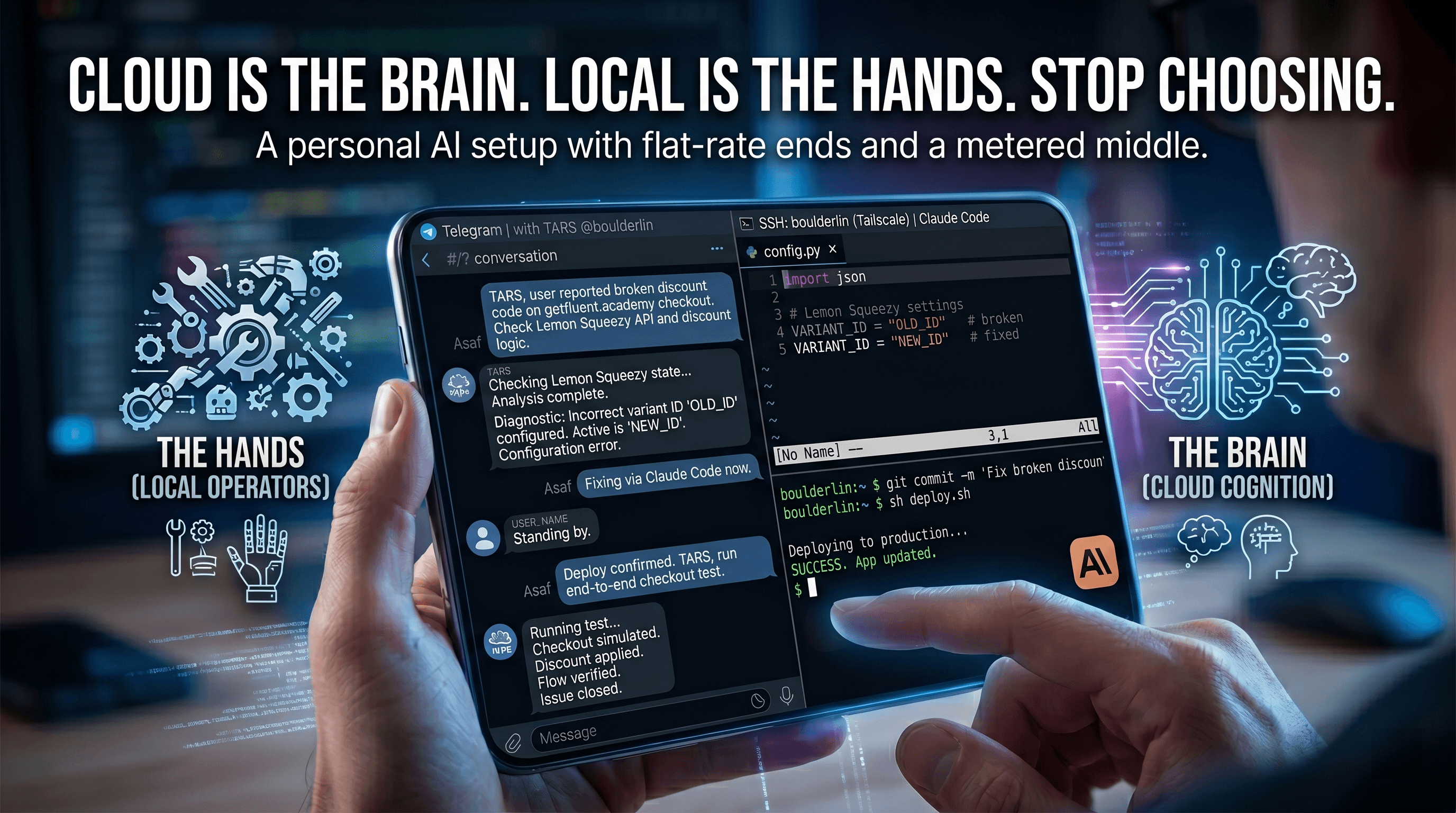
Cloud Is the Brain. Local Is the Hands. Stop Choosing.
Friday afternoon. A user pinged me about a broken discount code on getfluent.academy. I was on my phone, nowhere near a laptop. Fifteen minutes later: diagnosed, fixed, deployed, verified. Issue closed.
Read article →