Loading…
← Back to Thinking
Roadmap Inflation: Why Faster Prototyping is Breaking Your Planning
For years, my team lacked a modern web shop for demos and testing. The internal debate was a broken record: Who builds it? Engineering? Consulting? The Academy? Every quarter, "higher priorities" buried the project. We agreed on its value but cited a total lack of capacity.
A couple of weeks ago, Cursor with Claude and I built it between meetings in a single afternoon.
As a VP of Product, that should be an anomaly. It isn't. The takeaway isn't just the speed of the tools; it's the uncomfortable realization that follows: How much of our backlog is actually a capacity problem, and how much is just the tax we pay for traditional development cycles?
The Rationing Device
The product roadmap has been the central artifact of product management for decades. It exists because of a scarcity assumption: prototyping is expensive, so we need a rationing mechanism. You can't try everything, so you debate everything first. The roadmap is how you decide what to build before you build it, because building costs real engineering time.
AI collapses that assumption. When a Full Stack PM can spin up a working build artifact in hours rather than weeks, the "think before you build" logic partially inverts. Sometimes the fastest way to think is to build.
The Rise of Roadmap Inflation
This creates a new problem: Roadmap Inflation. When the cost of prototyping drops to near zero, the temptation is to prototype everything. Every stakeholder request gets a fast proof of concept. Every customer complaint becomes a demo. The team looks incredibly productive, but the "finished" product never arrives. You end up with twenty things built to 20% instead of four things built to 100%.
The discipline of "No" hasn't disappeared; it has just moved.
From Build Queues to Bet Registers
I am experimenting with replacing the traditional roadmap with a Bet Register.
A roadmap is a build queue: it tells you what you're going to do and when. A Bet Register is a portfolio of hypotheses: it tells you what you're currently testing, what you believe to be true, and what evidence would cause you to change your position.
On a bet register, every item has three components:
-
The Bet: The specific market or user hypothesis we are testing.
-
The Artifact: What we built (or are building) to validate it, such as a 4 hour AI prototype.
-
The Decision Trigger: The specific data or feedback that ends the experiment or moves it to the engineering core.
The roadmap question was: What should we build next? The bet register question is: What do we most urgently need to know, and what's the cheapest way to find out?
The Organizational Collision
This shift isn't just a process change; it's a cultural one.
-
Engineering as Architects, Not Just Builders: When PMs can generate artifacts quickly, engineering's role shifts from early stage discovery to high stakes architecture, integration, and scale. Engineers aren't "brought in later" to clean up; they are the governors of technical viability who ensure a validated "bet" can actually survive at enterprise scale.
-
Moving the Gate Upstream: If you used to say "no" at the roadmap, you now need to say "no" at the prototype. A prototype shouldn't be built unless the bet it's testing is explicitly ranked on the register. Without this gate, you get "feature theater" with lots of demos and zero shipping.
-
The Narrative Layer: Customers and boards still need a commitment artifact. The Roadmap doesn't die; it becomes a narrative document built on top of the bet register, rather than the source of truth beneath it.
The Question Worth Sitting With
If your team could prototype anything in 24 hours, what would you actually want your planning process to look like?
Most product teams are still running 2015 era roadmap processes while quietly using 2026 era AI tools on the side. Those two worlds are colliding. The teams that redesign their planning for speed, while maintaining the discipline of the "Bet," will dominate. The ones who just watch the collision happen will be buried in half finished prototypes.
I'm curious: Are you seeing "Roadmap Inflation" in your org? How are you shifting your gates?
Related Articles
Product Leadership · Sep 2026
Intent to Evidence: Glossary
The vocabulary of the Agentic Development Life Cycle, as I use it. Twenty terms across the frame, the six phases, the ideas, and the Full Stack PM role. A living page, updated as the series grows.
Read article →
Product Leadership · Apr 2026
Cloud Is the Brain. Local Is the Hands. Stop Choosing.
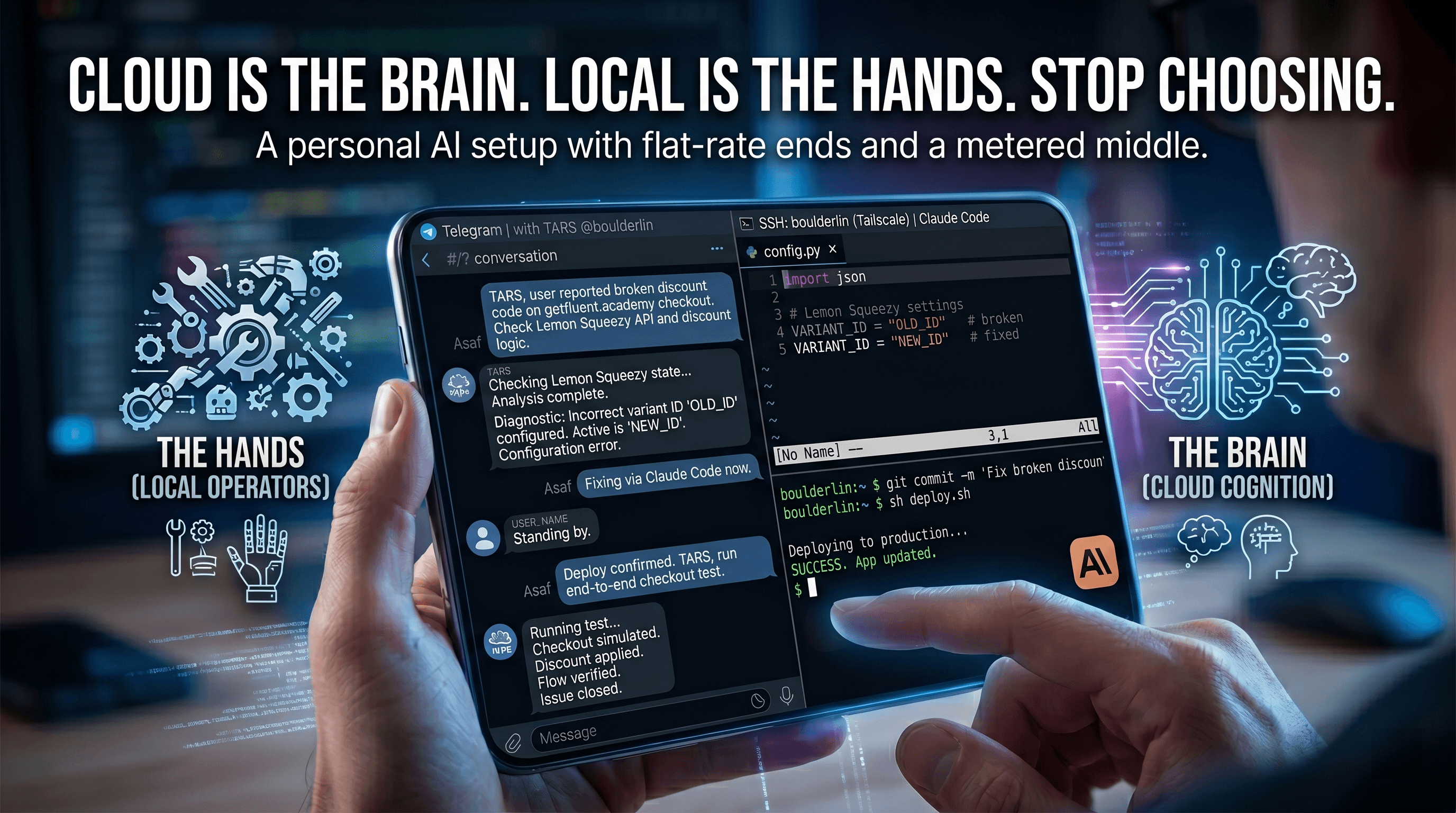
Friday afternoon. A user pinged me about a broken discount code on getfluent.academy. I was on my phone, nowhere near a laptop. Fifteen minutes later: diagnosed, fixed, deployed, verified. Issue closed.
Read article →