Loading…
← Back to Thinking

The Validation Bottleneck: You Can Build in 4 Hours, But Can You Learn in 4 Hours?
In the last article, I introduced the Bet Register: a portfolio of hypotheses replacing the traditional roadmap build queue. The logic was simple, stop debating what to build. Start testing what you need to know. Use AI to prototype fast, and let evidence drive the decision. /ski Several readers dropped me a message, asking more or less the same question: "Great, but how do you actually close a bet?"
They're right to ask. The Bet Register has an elegant-sounding failure mode, and I'm already seeing it in practice.
The Asymmetry
AI collapsed the build cycle. A Full Stack PM can go from hypothesis to working prototype in hours. But the learn cycle? That barely moved.
Getting a design partner on a 30-minute call still takes two weeks of scheduling. Enterprise feedback still arrives on a quarterly cadence. Behavioral data requires volume that a fresh prototype simply hasn't accumulated. You can build in an afternoon, but learning whether you built the right thing still operates on a fundamentally different clock.
The Bet Register only works if bets actually resolve. And resolution requires signal.
The Stockpile Antipattern: Validation Debt
Here's what it looks like when the learn cycle stalls: a team with twelve active bets, each backed by a working prototype, each "waiting for feedback." The dashboards look great. The demo is impressive. Leadership sees momentum.
But nothing is actually resolving. No bets are being killed. No bets are graduating to engineering. The prototypes just accumulate.
I call this Validation Debt. The silent successor to Roadmap Inflation. If Roadmap Inflation is twenty features built to 20%, Validation Debt is twenty prototypes built to 100% with zero market evidence. You aren't building a product; you're curated a "museum of maybes."
Most PMs reflexively blame the customer or the partner for slow (to none?) feedback. That's a strategic dead end. The real challenge is operational: how do you force the learn cycle to keep pace with an AI-accelerated build cycle?
Four Techniques That Actually Work
1. Instrumented Prototypes
If you're building a throwaway prototype, build it with telemetry from the start. Don't wait for a formal analytics integration. Lightweight event tracking, session recording, or a simple usage log tells you whether anyone engaged with the thing before you chase them for an opinion. The prototype isn't just a demo. It's a measurement device.
2. Structured Design Partner Programs
Most teams validate by sending a prototype link to three friendly customers and hoping for a reply. That's a prayer, not a program. A structured program means a standing cohort of 8 to 12 partners with a recurring cadence, clear expectations on response time, and a defined feedback format. You build the validation infrastructure once and run every bet through it.
3. Signal Mining From Your Existing Corpus
Before looking for new signal, extract the value from evidence you already own. Support tickets, NPS verbatims, sales call transcripts, and community posts are often treated as "noise" because no human has the bandwidth to synthesize 4,000 data points. AI changes the economics of synthesis.
-
The Technical Nuance: Do not dump raw data into a public model. Use a RAG (Retrieval-Augmented Generation) pattern or a secure enterprise instance to ensure PII and sensitive contract terms are under control.
-
The Strategy: Don't just ask "What do people think?" Ask the model to find disconfirming evidence. Search churn interviews for instances where customers explicitly rejected a similar concept. This turns a passive archive into a high-velocity validation engine.
4. AI as Adversarial Reviewer
Before you burn a design partner's social capital on a half-baked concept, run an internal gauntlet. This is Simulated Validation. Use AI not as a cheerleader, but as a hostile stakeholder to find the "obvious" holes in your bet.
-
The Strategy: Prime the model with specific, conflicting constraints. Have it role-play as a skeptical CFO asking why they should release budget during a hiring freeze, or an IT Admin worried about integration debt.
-
The Risk: Beware the LLM Echo Chamber. AI models tend toward flattery. You must explicitly instruct the model to be hyper-critical and to prioritize "Kill" over "Iterate." If your hypothesis can't survive a simulated skeptic, it won't survive a real one.
The Hard Limits
I want to be honest about where compression hits a wall.
Some bets genuinely need time. Market adoption curves don't accelerate because you want them to. AI speeds up iteration, but it does not speed up trust. Behavioral change in enterprise organizations happens over quarters, not days.
The discipline isn't about compressing everything. It's about distinguishing between bets that are slow because the signal is inherently slow, and bets that are slow because you haven't built the infrastructure to capture signal that's already available.
Put a deadline on every bet. If the signal is inherently slow, set the timeline accordingly and be explicit. If the signal should be fast but isn't arriving, that's a process failure, not a patience virtue. An unresolved bet without a deadline is just a prototype with a story attached.
The Question Worth Sitting With
What's your actual cycle time from prototype to decision? Not to "feedback received" or "demo completed." To decision: kill, iterate, or build.
If you can't answer that, you have Validation Debt accumulating. Unlike Roadmap Inflation, which is visible, Validation Debt hides behind the appearance of speed.
Related Articles
Product Leadership · Sep 2026
Intent to Evidence: Glossary
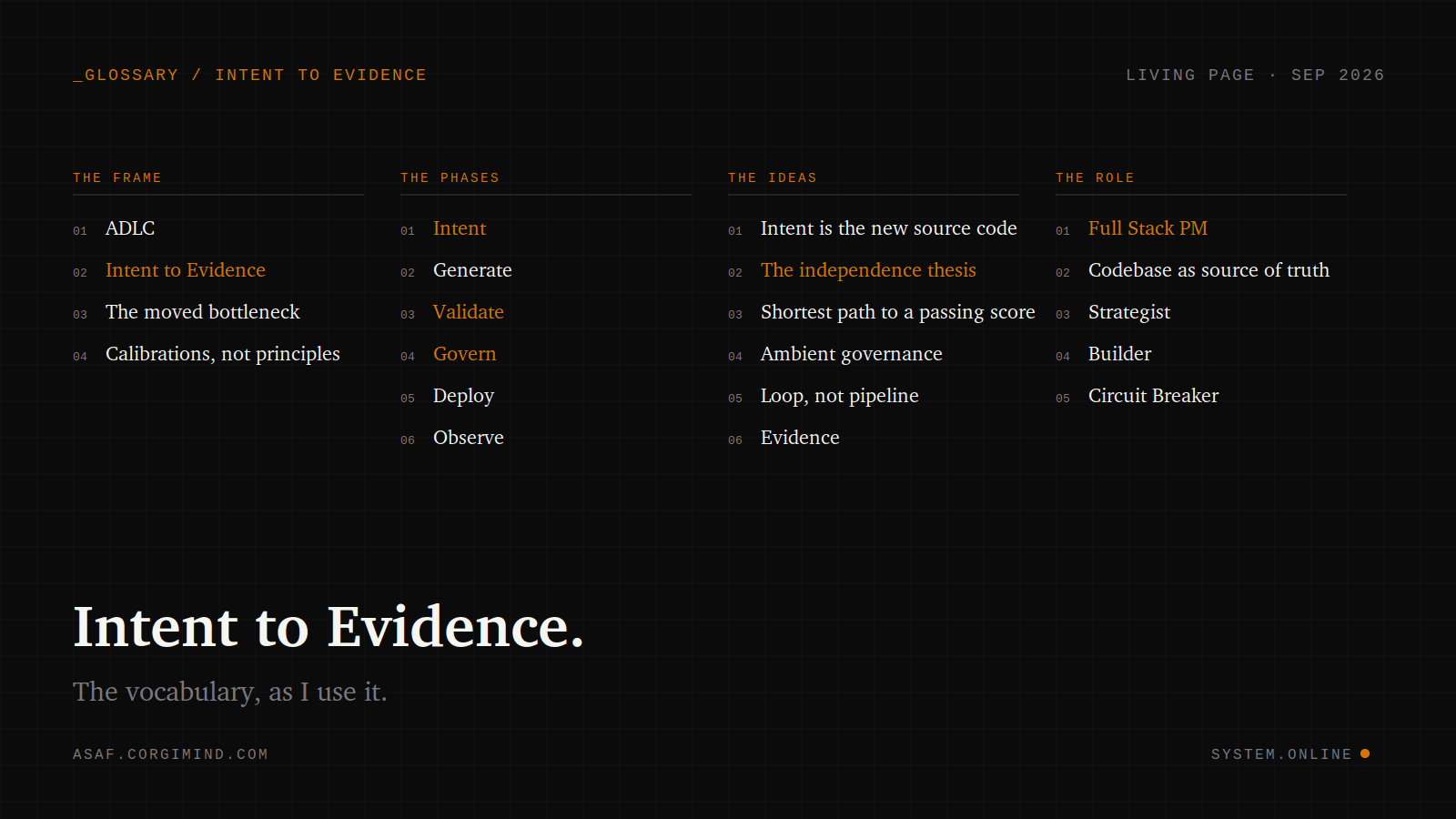
The vocabulary of the Agentic Development Life Cycle, as I use it. Twenty terms across the frame, the six phases, the ideas, and the Full Stack PM role. A living page, updated as the series grows.
Read article →
Product Leadership · Apr 2026
Cloud Is the Brain. Local Is the Hands. Stop Choosing.
Friday afternoon. A user pinged me about a broken discount code on getfluent.academy. I was on my phone, nowhere near a laptop. Fifteen minutes later: diagnosed, fixed, deployed, verified. Issue closed.
Read article →