Loading…
← Back to Thinking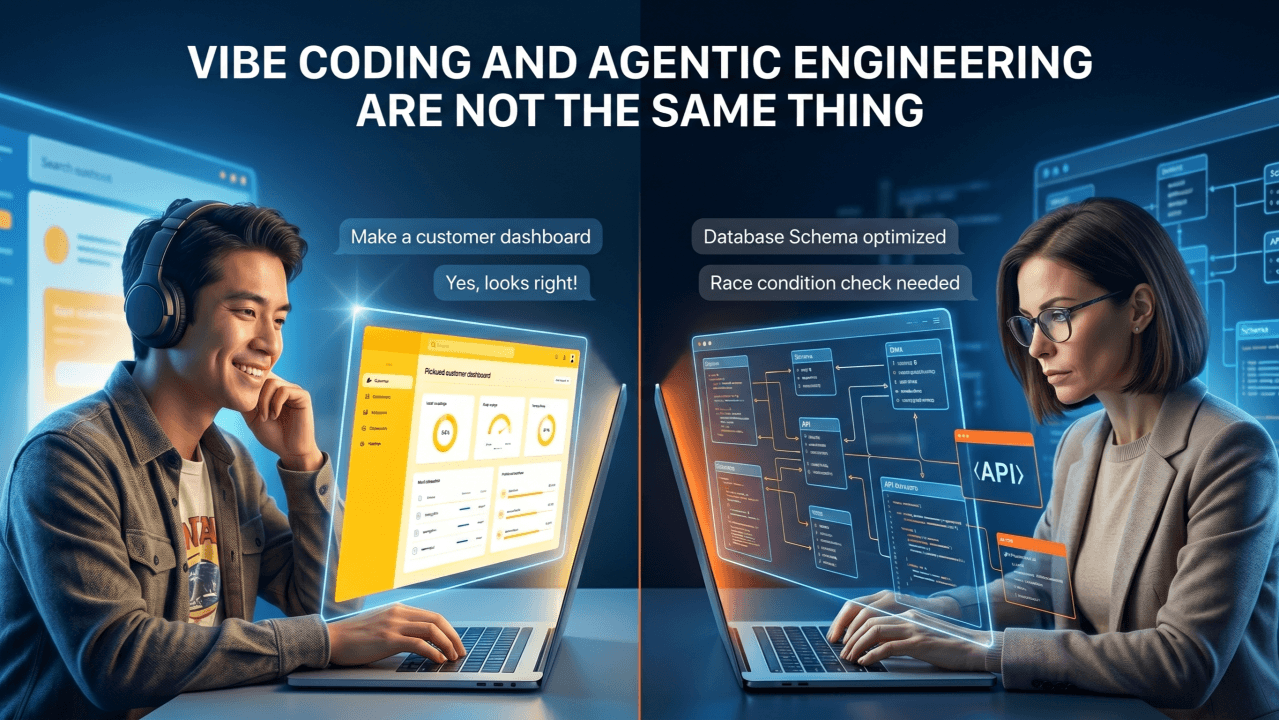
Vibe Coding and Agentic Engineering Are Not the Same Thing
Two people sit down with Claude Code. One has never written a line of code in their life. The other has 15 years of backend experience. Both ship something by end of day. The difference isn't obvious in the output. It shows up the moment something breaks.
Andrej Karpathy gave a name to something that was already happening. Vibe coding: you describe what you want, iterate on what comes back, and never look at the actual code. Non-technical people are shipping real products. Landing pages. Internal tools. Mobile apps. That's not a novelty — it's a genuine structural shift in who gets to build.
But somewhere in the excitement, the vocabulary started collapsing. Engineers using Claude to write complex backend systems started calling themselves vibe coders. Founders started using "agentic engineering" as a synonym for "I used AI to write this." And a meaningful distinction got buried in the noise.
These are not the same mode of building. And conflating them is starting to cause real problems for real people.
Vibe coding is about intent and outcome.
The vibe coder brings a problem. They describe a solution in natural language. They evaluate whether what comes back works — functionally, visually, experientially. They don't read the code. They don't need to. Their judgment lives entirely at the product layer: does it do what I want? Is the user flow right? Does it feel correct?
This is genuinely powerful. It moves the ceiling of who can build to a place we've never seen before. A domain expert with zero engineering background can now ship working software. That's not an exaggeration. I've watched it happen.
But it comes with a ceiling. And that ceiling is invisible from the outside.
Agentic engineering is something different.
The agentic engineer understands the code. Not every line — that's the point. But they understand the architecture being constructed. They know what a database schema looks like and why the choice matters. They can read a stack trace. They recognize when an agent made a reasonable, but wrong, decision about state management or API design. They retain ownership of the system while delegating the execution.
Think of it this way: the vibe coder is the homeowner describing the kitchen they want. The agentic engineer is the architect directing the crew — someone who knows what's inside the walls, how the load is distributed, and why you can't just move that column because it looked better in the sketch.
Both roles produce buildings. They are not the same role.
The distinction becomes undeniable when something breaks.
A vibe coder hitting an unexpected error has limited options. They can prompt around it. They can describe the symptom and hope the agent diagnoses correctly. Sometimes that works. But they can't read the trace themselves. They can't reason about a race condition. They can't identify why a caching strategy is causing data inconsistencies at scale. They're always working from the outside in.
The agentic engineer can look under the hood. They can evaluate what the agent produced, not just whether it ran. They can catch a subtle architectural decision before it becomes a two-week refactor. They can override, redirect, and course-correct with the precision of someone who understands what they're correcting.
This isn't about superiority. It's about fit. The vibe coder and the agentic engineer are solving different problems, with different tools, for different contexts. The confusion comes from the fact that both of them are typing prompts into a chat interface and getting code back. The surface looks identical. The depth is not.
This matters for how you think about what you're building.
If you're a vibe coder — and there's nothing wrong with being one — knowing your ceiling is not a limitation. It's information. It tells you when to partner with someone technical, when to validate what you've built before betting on it, and where your real leverage sits: product judgment, domain expertise, user empathy. The vibe coder who knows what they are can go remarkably far. And in many contexts — MVPs, internal tools, early validation — that's not just acceptable. It's the right call. Speed and cost are real advantages, and they don't disappear because the architecture isn't perfect. The one who doesn't recognize their limits ships technical debt they can't see and can't pay back.
If you're an engineer, an actual agentic engineer, "agentic" doesn't mean easier. The skills that matter have shifted, not disappeared. System thinking. Architectural judgment. Quality mindset. The ability to evaluate what an agent produces rather than just accept it. These are the differentiators now. The engineers who will pull ahead aren't the ones who outsource their thinking to the agent. They're the ones who think better because the agent handles what used to consume their time.
The vocabulary we use to describe these two modes of building will shape how we train for them, hire for them, and build tools that support them. Getting the distinction wrong isn't just semantically messy — it sets people up to fail in ways they won't see coming.
So: which one are you? And more importantly, do you actually know what that means for how you should be working?
Next in this series: what vibe coders need to understand about their own ceiling — and how to work at it intelligently.
Related Articles
AI & Product · Apr 2026
The Two Ways to Get Vibe Coding Wrong
Everyone warns about moving too fast with AI tools. Nobody talks about the failure mode that looks responsible from the outside — standing still while the compounding clock runs.
Read article →
AI & Product · Apr 2026
Vibe Coding Isn't What You Think
Vibe coding isn't the absence of thinking — it's a different interface for thinking. The bottleneck was never the code; it was always the clarity of thought upstream of it.
Read article →