Loading…
← Back to Thinking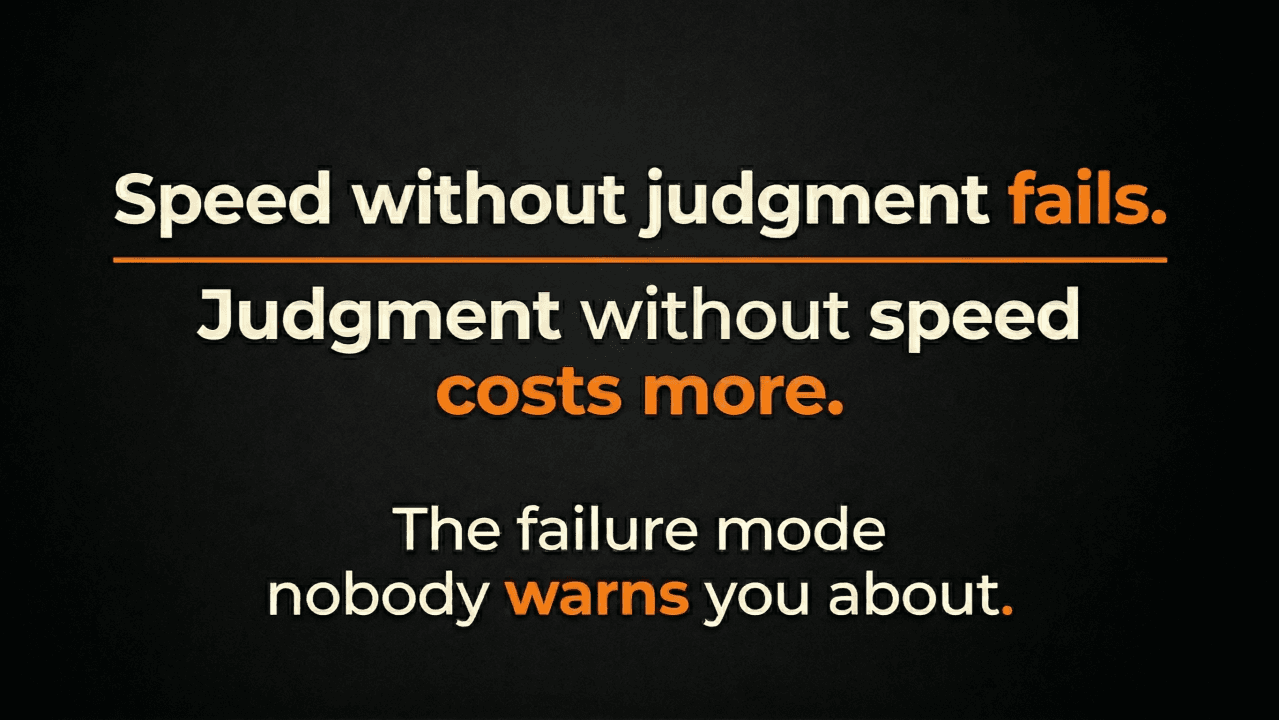

The Two Ways to Get Vibe Coding Wrong
Everyone warns you about the first failure mode.
Ship too fast, skip the thinking, accept whatever the AI generates, and you end up with a product that moves at the speed of your worst instincts. Brittle code, shallow UX, features that technically work and fundamentally miss. Speed without judgment isn't productivity. It's just faster failure.
That warning is valid. But it's only half the picture.
The failure mode nobody talks about is the one that looks responsible from the outside. The teams deliberating. The leaders waiting for the tools to mature. The PMs who acknowledge the shift is real but haven't changed anything they actually do yet. They're not moving too fast. They're standing still while the compounding clock runs.
Both are ways to lose. Only one of them feels safe while it's happening.
Compounding works in both directions.
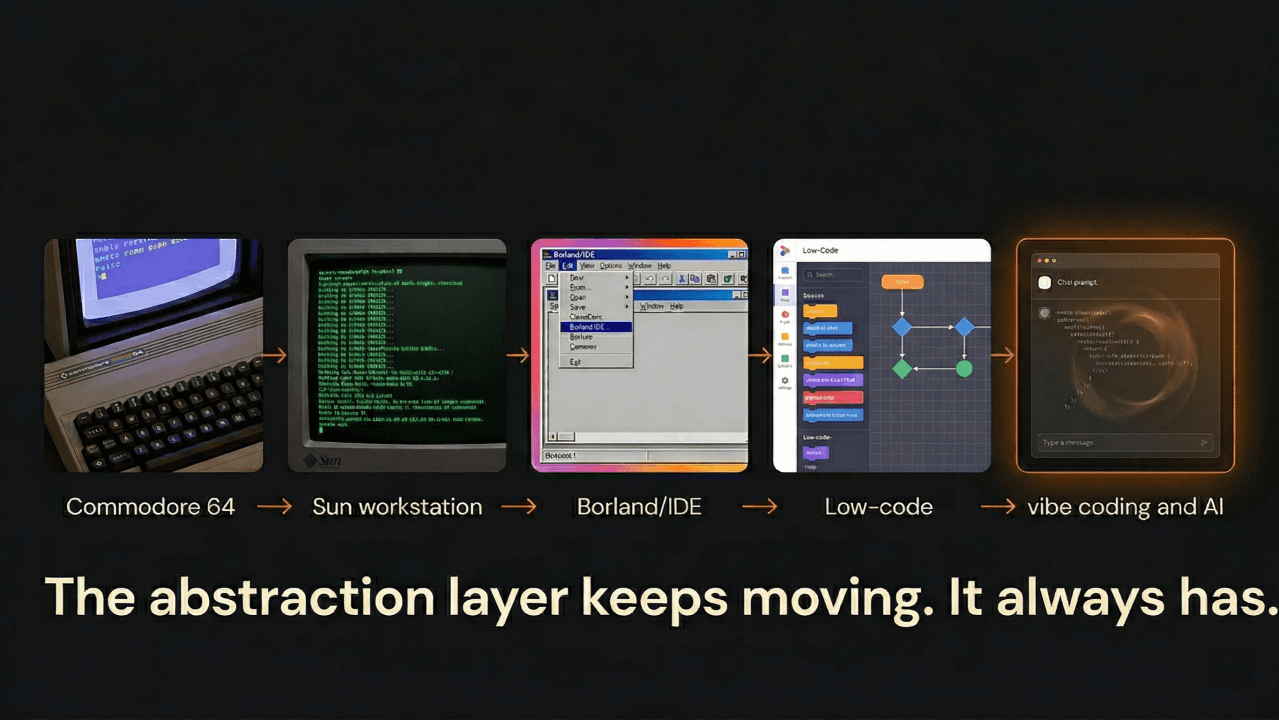
A software engineer commented on a previous article cleanly: "every generation of developers pushes back on the next layer of abstraction, and the ones who adopt early get a massive compounding advantage."
The word "compounding" is doing the heavy lifting there.
When a team internalizes a new capability early, they don't just gain the capability. They gain the reps. The intuition built from shipping ten things with a new tool is qualitatively different from the intuition built from reading about it. They develop taste for what the tool does well and instinct for where it breaks. They build on that foundation.
The gap between them and the team that waited six months isn't six months. It's the difference between two compounding curves that started at different times.
I've watched this play out four times across my career, from the Commodore 64 to Sun workstations to Borland IDEs to modern tooling. The pattern is consistent. Early adopters don't just move faster. They move differently. They've internalized a way of working that late movers have to unlearn their old habits to reach.
The vibe coding transition is running the same playbook. The compounding started already.
So what does judgment actually look like here?
If the answer isn't "move fast and skip thinking" and it isn't "wait until you're ready," what is it?
A practitioner in my comments nailed the sequencing: "Vibe coding got me started. Clean architecture kept me going. You need both, just in the right order."
That's it. That's the whole framework in two sentences.
I'd describe it as directed velocity. Moving fast, but with a clear hypothesis in front of every build and a sharp evaluative eye on every output. The AI handles the translation from intent to artifact. You stay responsible for the intent and the evaluation.
In practice that means three things.
First, know what you're building and why before you start the conversation with the AI. Vague briefs produce vague outputs. The quality of what you get back is a direct reflection of the clarity you bring in. This is what "pre-prompt discipline is the new code review" actually means: the investment that used to happen after the code was written now has to happen before the prompt is typed.
Second, develop taste for AI output. Not just "does this work" but "is this right." That's a skill that only comes from reps. You can't develop it by watching demos or reading about it. You have to do it badly a few times before you do it well.
Third, and this one is underrated: develop the judgment to stop. A senior PM in my comments made the sharpest point I've heard on this: low friction to build creates a new problem, low friction to keep building the wrong thing. When it's easy to make something, it becomes harder to kill it because the sunk cost feels smaller but the attachment doesn't.
The courage to kill what you built, vibe coded or otherwise, is where judgment actually shows up. That's not a technical skill. It's a product instinct. And it matters more, not less, when building is easy.
The distinction that changes everything.
One more thing worth separating out, because it came up in the comments and it's important.
Building to prove a point to someone else is a different act than building to compress your own feedback loop.
The first one is political. The second one is epistemic.
The PM who builds a working prototype before sprint planning isn't seeking permission or proving their worth to gatekeepers. They're arriving with evidence instead of assumptions. They're closing the gap between "I think this is right" and "I know this is right" on their own time, before the room fills up with opinions.
That distinction matters because the objection I hear most often is about organizational trust: "shouldn't a PM be trusted based on their track record, not their ability to ship code?" Yes. Absolutely. But that's not what this is about. Building to learn is not the same as building to be believed. One is about your relationship with your team. The other is about your relationship with reality.
The best practitioners I've seen get this right instinctively. They build because it's the fastest path to knowing. Not because anyone asked them to.
The trap that looks like discipline.
The most dangerous place to be right now is convinced that you understand the shift intellectually but haven't changed your behavior yet.
I see this constantly in senior product and engineering leaders. They've read the articles, used the tools a few times, have an informed opinion about where this is going. And they're still running the same planning cycles, the same validation processes, the same handoff patterns between strategy and execution they've always run.
Understanding a transition and internalizing it are different things. The gap between them is reps.
The leaders who will look back on this period with regret are mostly not the ones who moved too fast and shipped garbage. They're the ones who understood exactly what was happening and waited anyway, for the right project, the right moment, the right level of readiness. Meanwhile the compounding clock ran.
There is no right moment. There's just now, and later, and the gap between the two curves.
The move.
Use judgment to direct the velocity, not to justify the pause.
Know what you're building before you build it. Evaluate the output against a real hypothesis. Develop the taste to recognize when it's wrong. Build the courage to kill it when it is. Ship to something real. Do it again.
That loop, repeated with intention, is how you get the compounding benefit without the compounding debt.
Speed and judgment aren't in tension here. Judgment is what makes the speed compound in the right direction.
If this resonates and you're wondering how to develop the instinct without the trial and error, that's exactly what I built Fluent for. It's a hands-on practice environment where you learn by building, not by watching. The judgment, the reps, the feedback loop, all of it in one place. getfluent.academy
Related Articles
AI & Product · Apr 2026
Vibe Coding and Agentic Engineering Are Not the Same Thing
Both the non-technical founder and the senior engineer are typing prompts into a chat interface. The surface looks identical. The depth is not — and conflating the two is starting to cause real problems.
Read article →
AI & Product · Apr 2026
Vibe Coding Isn't What You Think
Vibe coding isn't the absence of thinking — it's a different interface for thinking. The bottleneck was never the code; it was always the clarity of thought upstream of it.
Read article →