Loading…
← Back to Thinking
It's Not Just PMs
"Sima, it's just a quarter of a shekel. Like a 25% discount."
A sixth grader said that, out loud, in a classroom in Israel last week. He said it after using an app called The Digital Mall, where students get a virtual budget and have to navigate sales, percentage discounts, and decimal conversions to figure out what things actually cost. The app checks their math in real time. The shekel-quarter-percent connection that had eluded him for months finally clicked, because he was inside the math instead of staring at it on a worksheet.
The app was built by his teacher.
Her name is Sima. I've known her for almost 40 years, since high school. She is, inside and out, a passionate teacher. Teaching is in her bones. She has never written a line of code. She has no background in technology. A few weeks ago, she sent me a WhatsApp message asking if my course on AI tools could help her build a math practice tool, some games, things like that.
She didn't wait for me to answer. She started building.
When I asked her what made her start, she told me she got tired of explaining percentages "on dry land," in the abstract, the way every teacher has had to explain them for the last hundred years. She opened a vibe coding tool, typed in plain Hebrew "build me a colorful discount calculator for kids," and watched the machine understand what she meant. Not the syntax of what she meant. The pedagogical intent of what she meant. The wall fell.
What she said next is the sentence I haven't been able to stop thinking about since.
"My creativity is the code."
This isn't a PM story anymore A few weeks ago I wrote about Chris Colosimo, one of the best PMs I've ever worked with, who pushed his first line of code to a company repo and had a small existential crisis about whether he was even allowed to do that. The piece struck a nerve. It traveled further than anything I've written. The comments became their own conversation, and that conversation taught me something the original article didn't say.
What's happening isn't a PM thing. It's not even a tech thing. It's much bigger than that, and it's already underway.
A quick walk through the cast Let me show you what I mean.
Chris is a senior PM. He built a pricing calculator because he was spending half his week explaining a complex consumption model to people who couldn't get there conceptually. Then he built a sales metrics app because the existing reporting wasn't organized the way he needed. Then dashboards. Then an auto-discovery tool. None of this was on his job description. All of it made him faster at the job he already had.
Andrew Prueser, a senior solutions architect who works alongside Chris at Tricentis, read the article and wrote a public response that landed harder than my original. His point: when you're privileged to work with a PM like Chris, you also have a responsibility to protect his time, to absorb the recurring drag so he can do the work only he can do. Andrew also named that he had often failed Chris in this. Senior peers rarely say that out loud.
Tom Payne, now VP of Sales at Narwal (and previously on the same team as Chris, Andrew and I), commented that he had built a browser extension for his LinkedIn outreach and a Python app to update his contact database from his email. He hasn't pushed anything to production yet. He used the word "yet" carefully.
The fact that Chris, Andrew, and Tom all came from the same organization isn't a coincidence. Some places have already crossed this threshold. Most haven't. The difference is almost entirely cultural, and it's almost entirely visible from the outside if you know what to look for.
Tamar Schapira, a founder I've known for years, replied that she had just celebrated her first GitHub push to production for her own company's product. Not a side project. The actual thing. She isn't a technical founder, and a few years ago a push like that would have meant filing a ticket and waiting. Now it means a Tuesday afternoon.
David V. Corbin, a senior software architect with three decades of edge-case scars, pushed back in the comments and then DM'd me with a careful, generous case for why deep engineering expertise still matters and how it has been getting cut out of the design phase for almost two decades. He's right. His pushback made the thinking sharper, not weaker.
And then Sima. Who, as of this week, has fifth and sixth graders in Israel learning percentages by shopping in a digital mall she built herself.
That's not a list of anecdotes. That's a pattern.
What's actually happening A senior PM. A senior solutions architect. A VP of Sales. A non-technical founder. A senior software architect. A schoolteacher. Six people, six roles, four industries, three countries. All of them, in the last few months, started building software inside their own work. None of them set out to become engineers. All of them ended up shipping something.
The thing that connects them isn't the code. The code is incidental. The thing that connects them is that each of them had a specific piece of their work they understood deeply and wanted to do better than the tools around them allowed. Some were removing friction that was eating their time. Some were extending what they could already do into something bigger. Some were doing things that simply weren't possible before, like a sixth grader walking through a digital mall to learn percentages. Until very recently, that's where each of these stories would have ended. The friction would have stayed in their calendar. The extension would have stayed a wish. The new thing would never have existed at all.
That's the gap. The gap between someone with deep understanding of their work and someone with the technical skill to translate that understanding into software. That gap is where engineering bandwidth lived. Where IT tickets lived. Where vendors made money. Where consultants billed hours. Where teachers handed out worksheets that didn't quite work, because building a real interactive tool was someone else's job and that someone else was always too busy.
The gap is collapsing.
It's not collapsing because AI is replacing engineers. David is right that some problems will always need decades of pattern recognition and specific scars. The cache poisoning class of failure isn't getting solved by a prompt. The deep edges still belong to the people who've earned them.
What's collapsing is the gap in the middle. The 90% of software that isn't deeply hard. The internal tools, the personal calculators, the small dashboards, the lesson aids, the outreach helpers, the calendar fixers. The category of software that real engineers have always known they shouldn't be writing but had to write anyway because nobody else could.
That work is now flowing back to the people closest to it. Sima for percentages. Chris for pricing. Tom for outreach. Tamar for her own product. The work is being done by the people who actually understand it.
What this requires Three things, in order of importance.
Permission, still. The Chris article was about that, and it's still the bottleneck for a lot of people. Saying out loud that it's okay to try. That it's okay to make a mess. That your job isn't going away. That you should go fast, be bold, and build the thing slowing you down.
Space, as Andrew named. Not just permission as a sentence, but room as a culture. Time. Trust. The willingness to let someone build something imperfect on the way to something useful.
Judgment about when to call in deeper expertise. Sima isn't writing a real-time-trading system. Chris isn't shipping security infrastructure. The new model isn't "everyone builds everything." It's "everyone builds the thing closest to them, and we still pay engineers like David to handle the parts that require thirty years of scar tissue." Both halves matter.
What I keep coming back to Sima told me, in the same WhatsApp message, that the moment that flipped for her was watching the machine understand her pedagogical intent without her writing a single line of code. Not the syntax. The intent.
Read that again. A teacher with no technical background described what's happening more precisely than most thought leadership has managed in two years. The interface to building software is no longer a programming language. The interface is your intent. The clarity of your intent. The depth of what you actually understand about the problem.
Which means the people who win in this era aren't the ones with the most technical skills. They're the ones with the clearest sense of the problem. The teacher who knows exactly why a sixth grader can't picture a quarter of a shekel. The PM who knows exactly which conversation is eating his calendar. The VP of Sales who knows exactly where the friction sits in his outreach. The founder who knows exactly what her product needs to do for her customer.
Domain knowledge was always valuable. It's now the most valuable thing in software.
Where this leaves us If you're reading this and you're a builder by trade, your job didn't shrink. It moved. The valuable work is now further upstream, in the hard problems and the deep edges, and you'll have more freedom to focus there because the small stuff is being handled by the people who actually own it.
If you're reading this and you're not a builder by trade, this is your moment. You don't need a credential. You don't need to become an engineer. You need a problem you understand deeply and the willingness to spend a weekend trying.
If you're reading this and you lead an organization of any kind, the people on your team are already starting to build. Some of them are doing it openly. Most of them are doing it quietly because nobody told them they could. The single most valuable thing you can do this quarter is say out loud that they can. And then make space for them to do it.
Sima didn't wait for permission. She had thirty years of teaching telling her exactly what her students needed, and a tool that finally let her express it. So she built The Digital Mall, and the kid she'd been worried about for months said the words she'd been trying to put in his head all year, and he said them because he was inside the math instead of staring at it.
That's the whole thing. The intent stays human. The expression finds a new medium. And the people closest to the work finally get to be the ones doing it.
This is the closing piece in The Builder's Mindset series. The conversations I've had over the last year, with the Sima's and the Chris's and the Andrews of the world, are the reason I know that's where the work is.
If you're working on something in that intersection, or thinking about it, I'd love to hear from you.
Related Articles
AI · SEP 2026
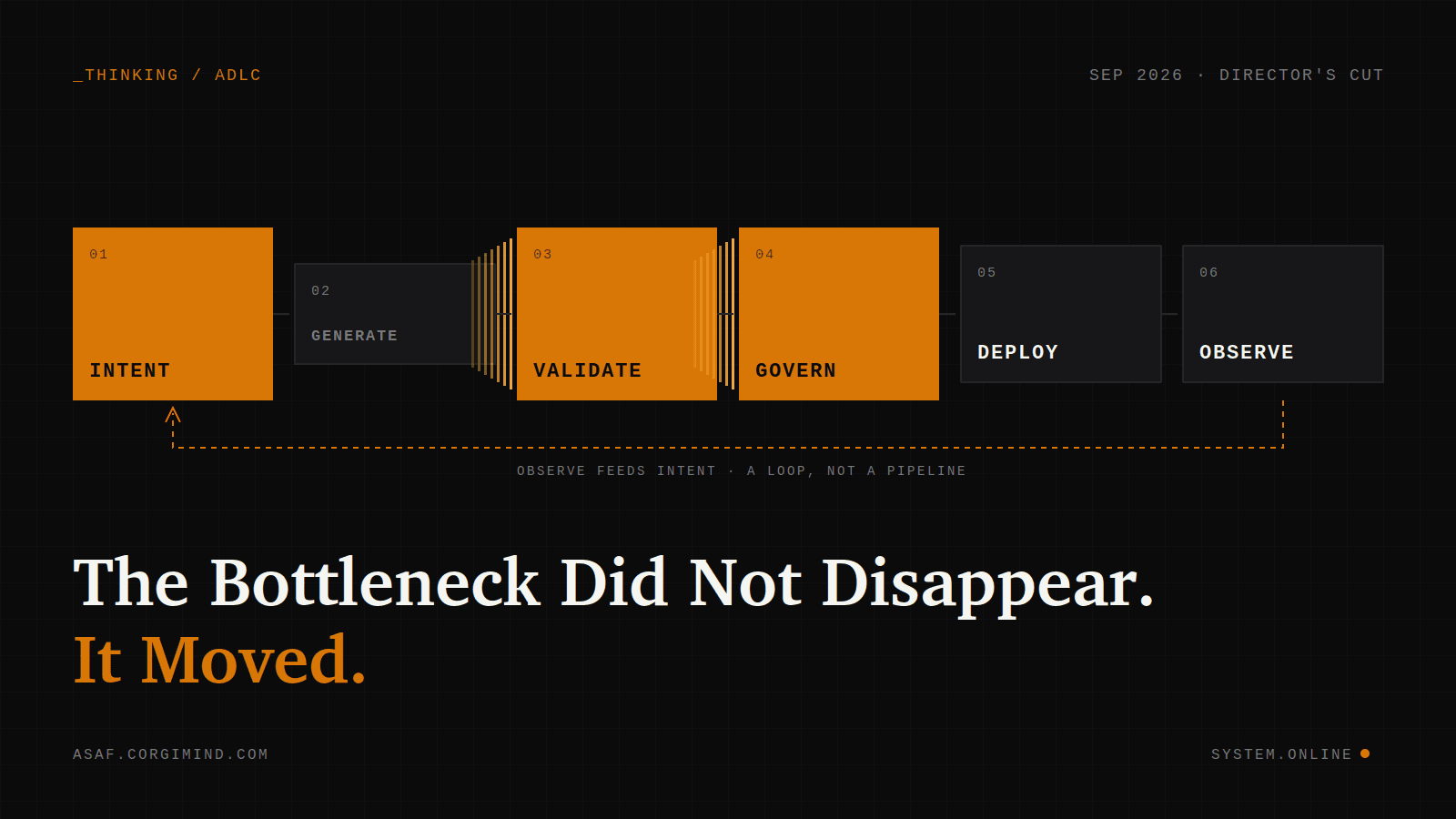
The Bottleneck Did Not Disappear. It Moved.
The SDLC had one assumption nobody wrote down: a human typed the code. When agents generate it, the bottleneck moves to Intent, Validate, and Govern. The longer version of the argument, with the objections and what it changed in how I build. LinkedIn URL: leave empty until Edition 9 ships, then add it.
Read article →
AI · JUL 2026
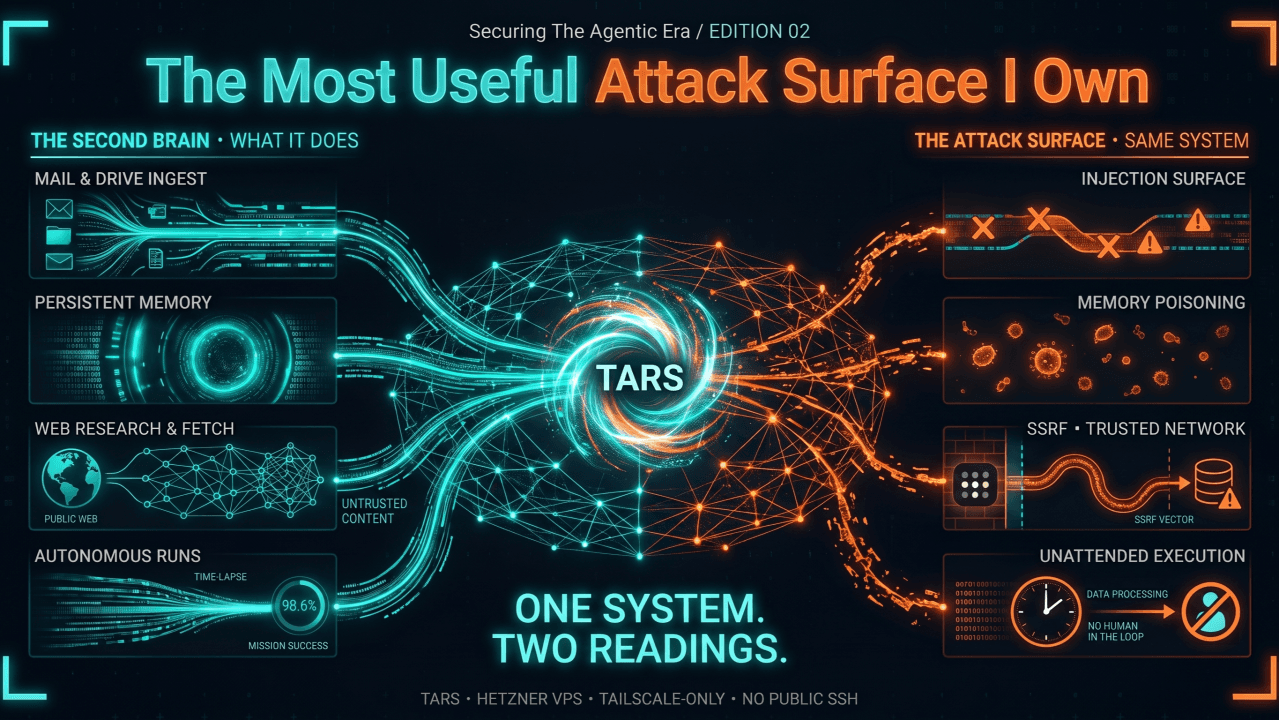
The Most Useful Attack Surface I Own
A few weeks ago I introduced you to TARS, my personal agent. He runs on a small Hetzner VPS, reachable only over Tailscale, and over the last two months he has quietly become my second brain. This edition goes deeper, into the security, privacy, and trust questions that TARS forces on me and that every agent now working its way into our lives will force on everyone.
Read article →